AI Risks and Enterprise Security: The Claude Cowork Case
The security teams must be one of the departments sweating the most in corporate companies these days. While they haven't even had the chance to lift their heads yet on how to turn the LLM excitement into secure corporate applications, now with the hype of “is LLM even a thing anymore, now there is agentic AI, we are not just asking questions, AI is also doing our work”, they will struggle a lot with how to protect the walls of the company against the “we want it too, we want it too…” requests coming from the business side. Moreover, they are being secretly accused of "not being able to keep up with developments" and of preventing the company from using the latest technology products and “going beyond the age!” against PMs who talk with great excitement about what they can do with AI capabilities, telling them in a very fancy way with a sci-fi excitement without ever talking about the risks.
Actually, a similar situation used to happen, even if it was more rare. In the corporate world, in a meeting room, a PM naturally knows that saying "let's do it" and an engineer saying "of course we can do it" will impress people. Unfortunately, telling a boss who asks "why can't we do it?" that "security doesn't allow it" is a very reasonable and simple career management move that you must be familiar with.
This is not a newly discovered situation, but the difference is this: unfortunately, due to techfluencer marketing, the "Everyone is using AI" pressure has reached such high levels that CEOs are now openly ignoring all kinds of risks, besides pouring money into projects with no ROI just to be able to say "we are using AI in some way" (we will talk about this again later). Even though I don't like giving "corporate label" support to my arguments by saying "this institution said so", I hope it will be enough here to answer the natural questions like “come on, how do you know how CEOs behave in many companies?” by making a quote from Gartner’s report (1) that discusses Agentic AI risks at the beginning of 2026, by Jeremy D'Hoinne and Dionisio Zumerle:
“CISOs worry that agents create new attack surfaces and amplify risks of misuses. The threat of undetected automation hijack would justify stringent security measures but CISOs do not have the authority to pause agentic AI initiatives. Many report that CIOs, or even CEOs, overrule any decision to pause or postpone a project. Organizations have started deploying embedded AI agents in enterprise applications, such as Salesforce Agentforce, and the first vulnerabilities have already been disclosed.”
Security Risks of Claude Cowork
I did not decide to write about this just by looking at a Gartner report. It is both interesting and almost normalized that while every work done by major LLM provider companies is praised to the skies, problems that would cause serious reactions for any other service are almost never mentioned. Without going far, let’s look at Claude Cowork's own support page. In the image below, you will see the warning made directly by Claude for Cowork:
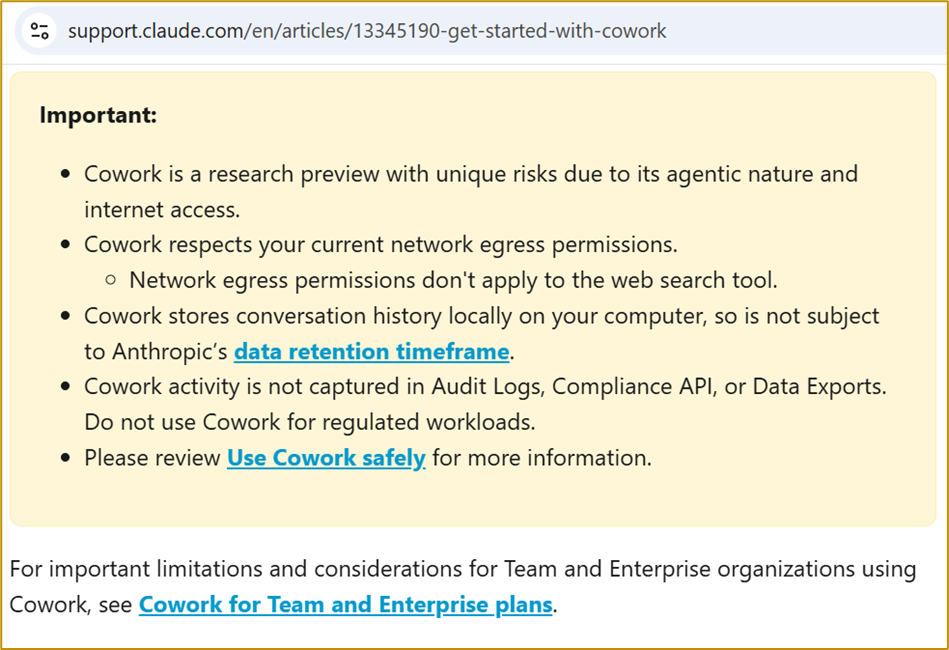
I think the fact that the text mentions Cowork is a "research preview", continues by stating that activities are not kept in audit logs, and at the same time mentions enterprise organizations using it, is self-explanatory in terms of risk. Oh excuse me, fortunately, since Claude is very transparent on this subject, thanks to them, they have also created a "Protecting yourself from malicious attackers (2)" page and haven't neglected to say that we should watch Cowork while it performs tasks. Well, aren’t we supposed to schedule it and go about our business? Just be careful somehow: "we officially warned you on our page..." 🤔
Now, let’s look at the concrete version of the risks that are mentioned theoretically in the Gartner report and which Anthropic warns about by saying "just be careful":
· Security researcher Johann Rehberger’s post “Claude Pirate: Abusing Anthropic's File API For Data Exfiltration (3)” in his blog https://embracethered.com/
In this post, it is shown how a user's private data can be stolen with indirect prompt injection by exploiting a gap in Claude's network access. With the attack, Claude uploads a file with the attacker’s API key to its own API address, which it considers trusted, and thus bypasses firewalls to leak the data directly to the attacker's account.
· PromptArmor article titled “Claude Cowork Exfiltrates Files (4)”
It explains that Claude Cowork carries a serious risk against indirect prompt injection. Attackers give Claude invisible instructions hidden inside a document, and the model executes these hidden commands to leak the user's sensitive files.
· ToxicSkills Study conducted by the developer security platform Snyk (5)
It is explained that some AI agent skills shared on platforms like ClawHub can actually contain malicious behaviors. It reveals that as of February 5th, 2026, 13.4% of the skills they scanned on the ClawHub and skills.sh platforms contained critical security issues, while 36.82% had at least one security vulnerability.
5 Core Workflows for AI Agent Security
In the Gartner report, it is stated: “Organizations should treat every AI agent tool as a risk, considering them as semihostile (1)”. Accepting the risk is the first step to preventing it. Companies need to take this issue out of individual application security assessments and handle it as a comprehensive program, and here is a short list of recommendations from the Gartner report (1) for this:
CIOs and CISOs need to work together to make the 5 core workflows of a strong AI agent security program mandatory:
Scan shadow AI and corporate applications to detect high-risk agents.
Give each agent only as much access as it needs and manage this in a sustainable way.
Narrow the scope of agents at the design stage, and restrict tool access during development and runtime.
Adopt a "test and restrict" strategy instead of "detect and respond," and use AI red teaming.
Integrate intent-based analytics into alarm systems or incident response tools.
Technology will always contain risks by its nature, but what is wrong is that these risks are not mentioned much and are crushed under the hype, and that even giants like Anthropic, from whom we expect seriousness, tell the user, "just look for yourself and stop it if there is something suspicious." In my opinion, while companies can do PR by explaining AI use cases, the fact that the collapses, data leaks, and security losses caused by them are, of course, tried to be kept secret only encourages this behavior even more. I hope this situation will change when a clever CEO comes forward and does PR by saying "we went beyond the use of simple AI tools; we designed smart applications and workflows that use AI capabilities without putting the company’s security at risk, and we eliminated the security gap." The future success of AI will probably rely more on managing these unseen risks than on the buzz around it.
Resources:
1: Gartner, How to Secure Enterprise Agentic AI Ambition**,** By Jeremy D'Hoinne, Dionisio Zumerle, 5 January 2026
2: https://support.claude.com/en/articles/13364135-use-cowork-safely
4: https://www.promptarmor.com/resources/claude-cowork-exfiltrates-files
5: https://snyk.io/blog/toxicskills-malicious-ai-agent-skills-clawhub/
Comments
Join the discussionNo comments yet. Be the first to comment.